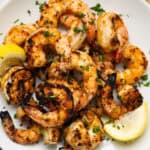
How to Peel and Devein Shrimp
Learn how to peel and devein shrimp quickly and easily with my handy guide! No fancy tools necessary, it's easier than you think!
Servings 1 shrimp
Calories 14kcal
Equipment
- Fork optional
- Bowl of cold water
Ingredients
- Shrimp whole with shell
Instructions
- If the head is still attached, pinch it and twist it off, and set it aside for stock. Using your thumb, slide your nail under the shell near the front of the shrimp, and slide down to crack it open along the underside.Shrimp
- Press your thumb further along the shell to peel back the rest of the shell. It should take off the legs with it; if not, they can be easily plucked off.
- Using a sharp paring knife, slice a very shallow slit along the top back of the shrimp to expose the black vein.
- Using a fork or your index finger, pull out the dark vein along the body of the shrimp. You can also use a toothpick.
- You can slice off the hard end of the tail if you desire- I like to leave it on to serve as a handle, but it's a matter of personal preference. Then cook, serve, and enjoy! Check out all my great shrimp recipes listed below for some ideas on where to start!
Video
Notes
-
- When you're using particularly small shrimp, you can skip de-veining them. However, I recommend removing the tails of very small shrimp.
-
- If you don't like touching the shell or legs (hey, I get it!), you can use a spoon instead of your thumb to remove the shell. Alternatively, you can use kitchen sheers or scissors to cut the shell open.
-
- You can slice off the tail entirely, or leave it on. For larger shrimp, I like leaving the tail on to use as a handle.
-
- Shrimp that have been frozen and thawed can sometimes be soggy and soft, making it hard to remove the shell. For these cases, try popping them back in the freezer for 30 minutes to 1 hour to slightly harden the flesh.
-
- The shrimp waiting to be shelled should be kept in a bowl of cold water to ensure they don't warm up too much; peeling shrimp can be a time consuming process!
- Nutrition is calculated for just one shrimp for your convenience.
Nutrition
Serving: 1shrimp | Calories: 14kcal | Carbohydrates: 0.2g | Protein: 3g | Fat: 0.2g | Saturated Fat: 0.02g | Polyunsaturated Fat: 0.03g | Monounsaturated Fat: 0.02g | Cholesterol: 25mg | Sodium: 113mg | Potassium: 23mg | Vitamin A: 36IU | Calcium: 11mg | Iron: 0.04mg
